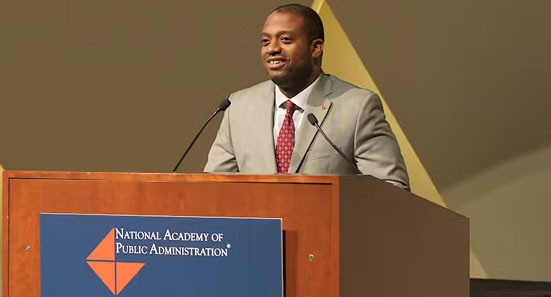
James-Christian Blockwood is the president and CEO of the National Academy of Public Administration. Their mission, delegated by Congress is to improve government. That’s good government, just listen.
GoodGovernmentShow.com Thanks to our sponsors:
The Royal Cousins: How Three Cousins Could Have Stopped A World War by Jim Ludlow
- Ourco
- Good News For Lefties (and America!) – Daily News for Democracy (Apple Podcasts | Spotify)
- How to Really Run a City
- Leading Iowa: Good Government in Iowa’s Cities (Apple Podcasts | Spotify)
The Good Government Show is part of The Democracy Group, a network of podcasts that examines what’s broken in our democracy and how we can work together to fix it.
Executive Producers: David Martin, David Snyder, Jim Ludlow
Host/Reporter: David Martin
Producers: David Martin, Jason Stershic
Editor: Jason Stershic
Transcription
David Martin: This is the good government show.
James-Christian Blockwood: We have the vision for a strong, representative government that works well for all, and we mean all to be inclusive of everyone. Our mission is to help leaders be more effective, efficient, transparent and accountable for government.
The conversation happens a lot at the federal level, but not knowing there are 90,000 plus units of government outside the federal apparatus, and everything that happens at the federal level has a huge impact on the state and local. Nonpartizan doesn’t mean without values, nor does it mean you’re immune from reality and what’s going on, and nor does it mean you remain neutral or paralyzed from engaging.
Issues aren’t just the responsibility of government, but they’re of communities and of whole of society.
David Martin: Imagine if Congress created an agency to work outside of government, but given the task of creating good government, imagine that agency growing to have over 1000 government experts who can consult on project across the spectrum of government. That agency exists. It’s called the National Academy of Public Administration. On this show, I talk with our president and CEO, James Christian Blockwood.
First, right now, wherever you are, subscribe to our show. Now. Follow us on all your favorite social media sites. Now that you subscribe, like us and share us. All right. That’s done. Good. Thank you. Here on The Good Government Show, I’m always looking for organizations that work towards good government. Better government organizations that aren’t part of the noise of party politics, organizations that have one goal in mind to remind all of the American people that our form of government, while it can be improved and what can’t be made better, but how American government works and works well, that’s how we came to know about the National Academy of Public Administration.
Founded in 1967 by Congress, this organization is a government resource that promotes and supports good government. As you’ll hear, they honor government workers with the prestigious Fleming Awards. Past award winners have included people like Neil Armstrong, Elizabeth Dole and Doctor Fauci. It’s a big deal. I recently attended their annual conference in Washington, D.C. and let me tell you, this is an impressive organization.
As you’ll hear, some really outstanding public servants make up their over 1000 academy fellows. These are people that are able to lend their expertise to projects and studies, all in an effort to make government run better. James Christian Blackwood, he heads up this organization, and on this show we talk about the Academy or Napa. We discuss the current state of government and how they remain a nonpartizan organization.
We also discuss some of the people in the projects Knapp has worked on that have helped improve government at all levels. We talked about the impressive government workers we both met. James Christian, what is inspired by the people he meets in government? I know I am coming up next. My conversation about good government and the National Academy of Public Administration.
The Good Government Show is sponsored by our. That’s oh you are for our community. Get involved. We hear that all the time from government leaders. Our co-branded with your government’s name and logo, your staff and the people you serve are connected and part of your community. From any device your members provide reliable data and meaningful feedback. Ask a question like do we want more parkland or better homeless services?
More engaged conversations come through the our app. Visit our Co that’s ou rco.com and book a demonstration.
Once you wrap up this episode of the Good Government Show, give a listen to our friends over at Good News for lefties. This daily podcast highlights news stories that show there’s more good news out there. Other people in government are really trying to do the right thing. That’s good news for lefties. Listen, we’re listening now.
Welcome to Good Government show. I am very happy to have with me James Christian Blockwood. He is the president and CEO of the National Academy of Public Administration. James Christian, welcome to the show. Glad to have you.
James-Christian Blockwood: Thank you so much. And thank you for doing the show.
David Martin: Well, we call ourselves the voice of Public service. I think you have eclipsed us. You. You’re not only the voice. You are the motivator. You are the proponent. And you are in Washington, DC, where you’re surrounded by people who work in public service. Let’s just start at the very beginning. Explain what the APA does. The National Academy of Public Administration, what’s your mission?
James-Christian Blockwood: Yeah, well, we first and foremost are a nonpartisan, congressionally chartered nonprofit. And we have the vision for a strong representative government that works well for all. And we mean all to be inclusive of everyone. Our mission is to help leaders be more effective, efficient, transparent, and accountable for government. And one of the things that we do to accomplish that is to use our thousand elected fellows that we have that represent the best of public administration, and that’s across state and local and federal government.
That’s across academia and that’s across nonprofit and private sector, entities. And, you know, the best way to probably think of us is, if you recall back to, it’s kind of hard not to at this point, but it is starting to be a fading memory. But if you call back to Covid 19, when we had a pandemic and people were trying to understand what was going on, and they had more questions than they did answers, people thought of the National Academy of Sciences and turned to them to ask those questions about Covid 19.
At a time when people really are thinking about and we’re having national dialog and debate about government and government operations, people should turn to the National Academy of Public Administration. That’s why we were founded. That’s why we were chartered by Congress, is to grapple with and to help government leaders solve these really complex government management issues.
David Martin: So you mentioned the fellows, and that was something I certainly wanted to talk about. We’ve already had a couple of fellows on. One of them was the the Extreme Weather Resilience Hub. We talked about a little bit, which was a Napa project. Do you recall that project?
James-Christian Blockwood: I do.
David Martin: Yeah. Pretty impressive. Do you want to just, tell folks your version of a synopsis of what that’s all about?
James-Christian Blockwood: Well, we have these major issues going on in our country. And one of them, just one of them is looking at extreme weather events. And how do we address that? And it’s not just one solution. It’s really a whole of government, whole of society solution. So what we did is we launched an extreme weather resilience hub, and we did this with bringing the entire community along.
So where do you have the federal actors, the state and local actors, private sector in terms of insurance, industry and others? And first responders, a place where they can come together, a hub of sorts to study best practices, to think about how to coordinate across issues, to think about how to be more proactive and not just responsive, but more resilient and adaptive.
And so, this hub, the concept was to look at different areas around the country, look at different issues so they can be fires. On the West Coast, they could be floods on the East coast, or they could be issues of heat and kind of, middle and center of our country. But looking at those various issues that have to do with extreme weather and helping to provide a mechanism for us to address it.
David Martin: And you had the former head of the National Weather Service leading, leading the charge, one of the many impressive fellows. There’s over a thousand fellows. We’ve had a couple of on the show. Louis Cellini, that was the first one. And others. And we’ve got others that are coming up, as a result of of meeting you folks at the National Academy of Public Administration.
Is there a is there a sort of a thread that runs through all of these fellows, like who these people are?
James-Christian Blockwood: Right? Well, first and foremost, they are outstanding leaders, and leaders in the field of public administration. To be elected to the Academy is to be considered among your peers. And the experts and those that have been with public administration for decades to be among those that have been most consequential to government and to the field. And if you think about our fellows run across different sectors.
And so think about in academia, it’s represented by some of your professors, deans, administrators, presidents of colleges and universities, at the highest levels. Think about state and local city managers, mayors, governors, and in private sector and nonprofit. Usually the leaders or those that are supportive of good government and public policy or public administration, and those that are, contributing currently or have contributed in the past, are then thought of as the ones that will help to provide solutions for the future.
And if I can just give you a few illustrative examples of some.
David Martin: Oh, absolutely.
James-Christian Blockwood: Yes, fellows. Sure. And this is this is not an.
David Martin: Exhaustive I don’t know if you picked the same ones I picked. So go ahead. I want, I want to hear we have so.
James-Christian Blockwood: Many to pick from. And so any one solo will exude the same qualities and characteristics as others. But I wanted to give a sense of kind of who we’re talking about. And if you think about, academia, you have Dean David Wilson at UC Berkeley, you’ve got Michael Crowe at Arizona State University and David Van Slyke at Syracuse, and they all are representing top institutions in public administration and public policy at different levels.
And they join a number of their peers throughout academia, throughout institutions across the country. At state and local level, you’ve got, Bryan Slater, who’s the current secretary of labor for the Commonwealth of Virginia. You’ve got Tanisha Briley, who’s a city manager at Gaithersburg. And you know, Matt Chase, who is an executive director of the National Association of Counties to represent all counties.
So you’ve got even, good representation there. And then even at kind of the private sector and nonprofit, you’ve got David Winograd, who’s the head of the American Council for technology, John Bartle, who leads the American Society of Political Administration. And they are equally just like the ones I mentioned before in many other fellows. And I, we don’t have the time to mention, have contributed either in the past or current.
And if if you allow me, you know, even thinking about the current context, we have fellows that are currently serving in administration and in major consequential roles. Think about what’s going on with the Federal Emergency Management Agency. Their current acting head, Karen Evans, is a fellow of the Academy, and even at something, as important to all of us as serving our veterans, the current deputy Secretary there, Paul Laurence, is an elected, fellow of the Academy.
So I could the list truly is exhaustive.
David Martin: Well, I’m not going to give you I’m going to give you my list. These are folks that are coming up on future episodes of The Good Government Show. Danny Werfel, he’s the former director of the commissioner of the IRS. We had, Jay Lerner, who’s a former inspector general in justice, Joel Spang and Burke. He’s the former director of the U.S Selective Service.
I didn’t even know the US Selective Service was still a thing. So I learned a lot. So yeah, I so we both have a pretty good list. I think.
James-Christian Blockwood: That’s right. All right. A very comprehensive one. I mean, think about the issue, the range of issues we’ve, we’ve, we’ve covered. And so that’s that’s great.
David Martin: What are you most excited about in the work of the National Academy of Public Administration?
James-Christian Blockwood: Yeah. Well, we accomplish our work through research, convening thought leadership and providing solutions to government. And I’m really excited for the opportunity ahead. You know, we’ve had a very challenging year, which we can certainly get into and talk more about. But I’ve really wanted to focus on opportunity. And one of the ways that we want to do that is through an initiative that we’re launching called Celebrating the American Public Servant, and it has three real components to it.
The first is to recognize, changemakers and champions across our country that have contributed to public administration and public service. The second piece is to do a research component on reimagining government and thinking about all that it took to get us to these current 250 years. And what is it going to take to make sure we have a productive and positive next 250 years?
And so doing the work of thinking through what our government needs to do and how it needs to change to be able to realize all that potential. And then finally, with a gala that brings together, all of those that support public administration, public service and government and want the best for our, our country, our government, and come together in celebration of each other.
And what’s really unique about this is many organizations have different award ceremonies, and they do that at the state level, local level, even at the federal government level. The Arthur Fleming Awards is one example of that. The Sammy’s in the service to the citizen Award. There’s many of them. This effort is going to bring all of those different organizations together and provide an opportunity for all of us to celebrate and recognize those accomplishments, those contributions, at one time and in one place.
And so I think that’s really special. It’s a unique moment as we celebrate our country’s 250th, it will bring, of course, different organizations will have their respective celebrations and award programs. But this is really meant to work across all the organizations, state and local, federal, all the different areas to which we want to highlight the good work that’s being done and celebrate collectively.
David Martin: So I’ve recently spoke with, a lawyer from an organization called Democracy Forward. And they are, you know, they are they are very concerned, and are bringing, you know, lawsuits to court, about the challenges to, civil service. And in some ways, you know, the conversation we had, you know, we’re going back to the time before Chester Arthur in 1883 and civil service reform, when it was a huge issue.
You know, when you look at what’s happening in the current administration, you know, how important are organizations like the National Academy of Public Administration, the partnership for Public Service, even the Good Government Show podcast? I mean, are we making a difference?
James-Christian Blockwood: Well, I certainly think, we’re making a difference. And I think we have, huge potential to make even more of a difference. And one of the things I think that before we even can talk about what that difference is and, and how all these different organizations are trying to do that is to go back a bit and try to unpack and understand how we got here.
You know, we we’re witnessing whether we are willing, willing participants or not or maybe being forced along this journey. But we’re witnessing a lot of change.
David Martin: Yes.
James-Christian Blockwood: And people can say disruptive disruption. You can say many different ways to define it. But, government is being remade and it might not be in the image that most of us might want or that might think is best, but it is being remade in a way that reflects what the majority of our, voters in this country have elected.
For them to choose that process and to choose that outcome. And that’s sometimes hard to accept. And, you know, organizations like the ones you mentioned and certainly like the Academy, what’s most important is that we remain nonpartizan and apolitical, and we make sure that we’re supporting government and democratic institutions. In the ways that we believe match our values and match the experience and expertise that we have.
And, we really need to make that investment. And so I think these groups are important for that reason.
David Martin: How can we steer, I guess, the conversation, to the ways that, you know, the, the Napa supports.
James-Christian Blockwood: Yeah. I mean, I think again, I go back to we’ve got to we’ve got to understand what what’s the context of the situation. Our country right now has so much division in it. We don’t have civil discussion and debate and dialog. And unfortunately, the words that we use are more harmful in the approach that we use is very harmful.
And, and, and you have to understand kind of people’s different perspectives. I mean, let me just give some illustrative examples of where I see things being very complex and quite frankly, my introduce a little bit of contradiction there. We’ve had we we talk about democracy and we have a current president who won the Electoral College, the popular vote, and every single swing swing state.
And yet we question democracy. You know, some could argue that’s democracy at work, and others could argue that, democratic values and a democratic institution is what they’re questioning in terms of are we following currently the rule of law? Are we promotion? Are we promoting human rights and freedom? Are we thinking about equality and fairness, accountability and transparency, freedom of speech and expression?
Are we thinking about it in the ways that we understand democracy to promote? And so there’s a little bit of contradiction there. Another example might be when we talk about merit, merit meaning everyone has access to opportunity, inclusion, promoting skill and competence. There’s no there’s no discrimination in the hiring a promotion process or even admissions into schools.
Yet there’s attempts to redefine and potentially eliminate, diversity, equity, inclusion programing. You know, equity is not a bad word. And Dei or just letters until you give them meaning. And everyone should agree that we want inclusion, and you don’t want that to be to the exclusion of anyone. And we want it to be in the widest definition, political ideology, all sorts of backgrounds.
Yet we’re having conversations about whether we’re all in agreement as to what merit looks like. And the last example I’ll give here is we’re having a, a conversation around our own culture. And, you know, I think it’s our culture is eating itself. I think with all the hyperbole and the hypocrisy, we’re having really hard time understanding definitions of words and how to move forward.
So here’s how I think the Academy really helps to move things forward, and where I think we have an outsized role to play. And I think this past year we’ve tried to demonstrate that value, which is an organization that’s nonpartisan, an organization that is rooted in evidence and data and research and looks to the truth to drive decision making and performance and outcomes and contribute to healthy discussion and dialog, inviting everyone in and having convenings that are geared towards being constructive and not destructive, and using language that doesn’t continue to add fire to already heated discussions.
And so I think that’s an important role to play, particularly when things are so complex and so contradictory in this moment. And I think the Academy has a huge role in doing that.
David Martin: I want to talk briefly about the conference I attended in November in Washington, National Conference for you. Just some of the sessions you had, bridging the gap, state and local capacity in a shifting federal landscape, transforming public governance institutions. The future of public administration, education, impacts on federal actions in academia. Those are just some of the things that jumped out at me.
Some of the sessions I attended. Was there a theme that ran through, this year’s conference that you took away from?
James-Christian Blockwood: Yeah. I mean, I’m in same the same context I’ve been trying to provide is opportunity. And it when you have so much uncertainty and so many things happening at a, at a pace to which people find hard to keep up with, it’s about how do you think about these issues in a constructive way. And, when you look at our state and local panel, the conversation happens a lot at the federal level, but not knowing there are 90,000 plus units of government outside the federal apparatus.
And everything that happens at the federal level has a huge impact on the state and local. And really, it’s your state and local public administrators and public servants that are delivering the services and are executing. And so that panel is to highlight what’s happening on the ground and how they are reacting to the moment and how they continue to serve.
One of the other panels you mentioned in terms of reimagining government, there’s many ways to think about that, and there’s many organizations and a lot of funding going to how exactly to get it to get at what should government look like. And we attempted to bring those different, diverse perspectives. So if you look at that panel, it represents across, many different organizations that sit in different places ideologically and try to have a conversation around outside of the politics.
Let’s talk about how do you best serve the American public, what is government’s fundamental role, and how do you help it see the opportunities that are there to rethink, what it should be doing? And that’s not necessarily to get into a lot of the approach and how things are being done right now, because that, there’s a lot to be said there and there’s a lot of lessons that can be learned.
But that panel is really to think about what’s the way forward and how can we offer, positive, productive and constructive solutions to where government needs to be. And so one other session I’ll mention is we had, the director of the Office of Personnel Management there to have a conversation about what the current administration is doing in terms of bringing, talent into federal government, managing that talent and setting expectations.
And I thought that was a very good conversation to kind of hear what the strategy and the plans were. But also a good opportunity for, the director to hear from some of the fellows and some of the participants on what are different ways to think about it. What are, different pieces of feedback on the current approach that perhaps could, could change and be done and executed differently?
And so to your question, I thought we had an amazing national conference that invited people in, covered, a lot of territory. And hopefully stimulated a lot more discussion that will take into the next year.
David Martin: Are you concerned by what you’re seeing at the federal level? And are you, encouraged by what you’re seeing at the state and local level?
James-Christian Blockwood: I think the state and local administrators and public servants have always served us well. I mean, they’ve done that under extreme, tight, extremely tight budgets and conditions. So I’m not concerned in terms of their ability to execute. I am concerned with the pressure that they are receiving and all of the things that make change at the federal level that put on new requirements or constrain their ability to execute as they have in the past.
And, and so it’s, it’s it’s more thinking about it as how to provide the help needed for them to continue to do that. Less concern at the federal level. There’s there’s more concern necessarily about the approach. Thinking about, do we have the right leadership, the right strategy, benefiting from the right lessons learned and experience and expertise of others?
And that’s it’s not as much of a concern as I see it as an opportunity. And how can the Academy and how can our fellows help our current government leaders see the value that we have to offer and help chart a course that is aligned with the outcomes that government wants to achieve, but offers an approach that will help achieve those outcomes in a better and a better way.
David Martin: Which is kind of the only approach you can really take, right? Because otherwise it’s it might just be too grim. So, so there’s there’s a lot.
James-Christian Blockwood: To be said by and following, and learning from history and using evidence research data, and different resources to get at the outcomes we’re all trying to to see.
David Martin: So I do, I do want to talk briefly because you mentioned it briefly, and this is what brought me to the National Academy of Public Administration in the beginning is, the Fleming Awards, which are a very prestigious award that gave out to, we talked to a person who, was instrumental in bringing a freshwater program to Indian reservations and, an attorney who got a, the largest settlement by Justice Department for, a faulty diesel system.
Some of the other people did stuff. One of the, one of the recipients was working on ultra processed foods. There were a couple I didn’t understand. So there, they were very intricate, and they’re very detailed. Just briefly, I know we’re going to talk more about this in future episodes. Tell me about the Fleming Awards.
James-Christian Blockwood: Yeah, an amazing, amazing program that recognizes outstanding public, servants, across a number of different areas. The first thing I would say is, and I say this with a lot of humility. As a Fleming Award winner myself, I look at these winners and I am just in awe, and I understand the contributions that I’ve made.
But I try to understand the issue, the issues that they’ve tackled and taken on or the innovations that they have brought to government. And it is incredible. You know, one example and.
David Martin: These are two people that are doing their job.
James-Christian Blockwood: That’s right. They’re not looking for any praise. They’re not doing this with with anything other than they want to serve, their government. And they’re being given the opportunity and resources to do so. And these are the results they’re getting. You know, one example that’s fascinating to me is you had an individual that was the one Fleming Award winner that was improving upon how we, capture and tell time was it was something that was amazing and in my view, but let me just highlight something that I think is a distinction for the Fleming Awards.
They have the endorsement of their agency leadership. So this is not just an external organization that highlights the good work that public administrators are doing. It’s bringing these things to to life and helping to share what their accomplishments have been with the endorsement of their agencies, agreeing that they’ve had that level of impact on the agency, on government and on their communities and on society more broadly.
And I think that’s a unique aspect. And so, again, a very powerful program. It’s usually only about a dozen of these leaders every year that are selected for this very prestigious award. And there are so many, that are also doing really good work. It’s, it’s unfortunate we only highlight 12, but it’s an amazing 12 to, to to look into and learn more about the work that they’re doing.
David Martin: What really stood out to me was the doctor who was studying ultra processed foods. My my thought was like, I didn’t know the government did that, you know? And that’s what kind of struck me was it was a lot of these award winners was like, you know, and I think this is I, you know, I hope people get this is there are so many people in government and you probably know better than I and please come in who are doing incredible work that only the government can, can support and sponsor.
James-Christian Blockwood: That’s absolutely right. And, you know, some of the things that this show does in terms of just elevating the voice of public service, some of the things that the Arthur Fleming Awards do is to bring those things to light. There are so many things that are happening in government, good work that people benefit from every single day that we’re just unaware of.
And I think, is the country new, even, a quarter of how hard, public servants were working on their behalf and the things that they were doing, our levels of trust in government and, people’s confidence that government can really support them and positively impact their lives. I think we would see those, go up and by large measure.
David Martin: So you lead the National Academy of Public Administration. You’ve only been there for about a year. So what’s your philosophy on leading this organization that you just stepped into? Where do you see yourself and your leadership going?
James-Christian Blockwood: Yeah, I really appreciate the question because it’s, a new endeavor. And this has been a challenging year. And so this is the, the, the right time to really think about what are your values and how do you lead and what type of impact do you want to have. And so I was, encouraged by thinking about this.
And I started with wanting to be constructive. That was a principle that I wanted to stick to. I wanted to be strong on our organizational values and not, shy away from that. And most importantly, I wanted us to stay nonpartisan. I know that’s increasingly complex to do. But I would also say nonpartisan doesn’t mean without values, nor does it mean you’re immune from reality and what’s going on.
And nor does it mean you you remain neutral or paralyzed from engaging. It just means to me you are constructively engaging, looking for opportunities to be positive and productive, calling things out when you see them with the appropriate evidence, and then staying out of politics and personalities, but yet remaining relevant and able to provide recommendations that help.
David Martin: A lot of people. Talk about being nonpartizan and wanting to be nonpartisan. And here on the show, we try to, you know, be nonpartisan as well. It’s not easy.
James-Christian Blockwood: You’re absolutely right. In fact, it’s quite, quite difficult. One of the things that can help is to have, and I have the great fortune of having this, but a diverse group of stakeholders that can represent different views. Our fellows come from various sectors and various, ideological perspectives. And I found a great value in bringing all of them together and trying to have collective conversation about different issues.
And we don’t always see eye to eye. But what happens in the end is we get to a place that, helps us move forward in the most productive and probably in a place where we have the most agreement and opportunity to move forward together.
David Martin: Well, I was talking with one of your fellows recently and they said, we agree on 90% of governments, right? With 90%. We all want the roads to be, you know, maintained. We want clean water. We want clean, you know, clean air. We want, kids to be educated. So that’s that’s the easy part. It’s then we get into the weeds of the hard part.
Right? I mean, that’s the challenge, right?
James-Christian Blockwood: You’re absolutely right. I mean, that last 10% is pretty tough to get to. And if you ever get there, I what I think though, is really important is the the effort and and trying to get there that that peace and having constructive dialog is something that we’re starting to lose sight of and we’re not doing as well as a country.
But that is where I think you’re going to see the most opportunity. And I’ve seen it as my job as president, CEO of the Academy to bring our fellows together. But even more broadly than that, to bring this public administration, this good government community together, to kind of see through those differences. And where can we really make a difference and help government?
David Martin: One of the things I constantly hear from local leaders is I don’t care whether there’s an R, a D next to your name. When my potholes on my street, I want it filled, I want it fixed. That’s how does that translate at a federal level?
James-Christian Blockwood: You know, federal government has a a really hard time because it’s really hard to really show direct impact on services. That’s usually been or showed at the state and local level. And then you just have so many more fraught issues. You know, if I can take a relevant issue right now, I get to look out my window.
And previously I would look out and I would see the Black Lives Matter Plaza, and I just saw some news that, that’s potentially going to be replaced, or at least there was legislation introduced that it would be replaced for Memorial for, Charlie Kirk. And this shows the complexity that happens at the federal level that then has a state and local impact.
Both of these issues are fraught. Black Lives Matter clearly a really important issue. And certainly those lives matter, as do all lives. And then Charlie Kirk, no one should be murdered for espousing the same principles we can all agree on in terms of free speech, free expression of those speech, and someone who really wants to bring civil discourse, to the people.
So you’re looking at at the federal level, you’re looking at the federal level. These issues that come up that have so many political implications to them, it’s much harder to deal with at the state and local level. They’re really dealing with services, and they’re closer to the people, closer to the issues. And so it’s, it’s easier and better to focus on the management and implementation of that than it is the politics and policy as it is with the federal.
David Martin: Level getting back to being nonpartisan with good leadership. That’s right. Do we get it?
James-Christian Blockwood: I think it’s it’s it’s tough to get you know, let me give you one image that sticks in my mind that makes it really, clear on how complex this is. I look back to President Carter’s funeral, and I saw, President Trump and President Obama having a what seemed to be a delightful exchange. And I thought to myself, here are two individuals that had serious issues, accusations and, grievances against one another.
And because of those things, people really lost their livelihood. They lost family and friends over different conversations and political views and in some cases, even worse. And you yet have these two individuals, one that challenge the legitimacy based off of whether they were an American citizen and another that challenged legitimacy, or whether they are a threat to democracy coming together and laughing and and having an exchange that seemed, hard to understand if those were the seriousness of the accusations that were being levied against them.
And here’s where that image took me right back to the mission of the Academy. And that is why it is important to be nonpartisan, focus on the the effectiveness, efficiency, accountability and transparency of government, and stay away from the politics and the policies which are, much more complex to deal with. And really, a different part of the work that, needs to happen in government in a part that is best left to others, where the academy can focus on how do we help government operate in the most effective, efficient, accountable and transparent way.
David Martin: So before we get into our questions, there’s one other thing I want to ask you about, because I must you put out a paper, last year, what does good government look like? What does good government look like?
James-Christian Blockwood: Well, it’s hard to define. And I think it’s one of those.
David Martin: You don’t say.
James-Christian Blockwood: It’s one of those things. You know it when you see it and you absolutely know what it’s not right. And I think fundamentally, I would say it’s, a government that represents and serves the people, serves all of the people, and serves all of them well. And so there’s a lot to unpack there. But that’s how I would start with, defining good governance.
David Martin: All right. Well, we’re going to get back to more of that in just a moment.
It was called The War to End All Wars. But it didn’t. Three royal cousins, all kings, one from England, one from Germany and one from Russia blundered their way into a war, a completely avoidable war that left millions dead in the trenches across Europe. Good government show executive producer Jim Ludlow details the blunders, mistakes and bluster that started World War One that didn’t end all wars.
The book The Royal Cousins details the events and creates an alternative history. Imagine a World War one never happened. It didn’t have to just read it yourself. Download the book today on Amazon. It’s just $0.99 and a timely look at history.
After you get done with this episode, hear more good government stories with our friends at How to Really Run a City for mayors. Kasim Reid of Atlanta and Michael Nutter of Philadelphia, and their co-host, journalist and author Larry Platt talk with guests and other mayors about how to really get stuff done in cities around the nation. Check them out where you’re listening now or through their nonprofit news site, The Philadelphia Citizen.
Dot org slash podcasts. That was the hard part. This is the easy part. Are you ready? This is the easy part, I promise. First question define good government. I know that you just did a little bit of that. Now we’re going to get to your philosophy. What is good government to you? What does it mean? What is it?
You know.
James-Christian Blockwood: I do stick with the bigger promise of it is a government that serves the people and serves them well. But I think there’s a way in which that happens. And you look for principles of public administration, which I would apply to good government, which would be you want a government that is effective. You want a government that is efficient and looks for ways to utilize resources.
You want a government that is transparent and offers the public an insight into how it’s serving them and which data it is using to do so. And you want a government, above all, that is accountable. Accountable to the people, and one that understands the great power that is invested in them and entrusted in them, for leading for leading the different government agencies.
And so good government is obviously one that is representative, one that serves all people. And it’s not to the exclusion of anyone. It’s hard to do, but really looks out for the interest of everyone. And it’s one that values, equitable outcomes and takes that into consideration to ensure that all parts of our country are being served in the ways that they need, and one that seeks to do effective, efficient, accountable and transparent government to make it in its simplest form, it’s a government that provides the American people what they want, need, and deserve.
David Martin: If people are frustrated with government, especially at the federal level, where it’s kind of hard to get Ahold of folks and reach out to folks, what should they do?
James-Christian Blockwood: Yeah, well, frustration is one thing. If you get frustrated to the point where you want to see a real change. First and foremost, I would say vote. That is the greatest power of the American person is to be able to vote, then get involved with whatever skills you have to offer that can be, providing research.
It can be organizing to be running for office. It can be contributing as a storyteller about your story, about someone else’s story, about what they’re experiencing. But do all of that with an eye towards really helping to address the problem.
David Martin: But that’s hard.
James-Christian Blockwood: Of course it’s hard. This is not this is not an easy proposition. The one thing that’s not hard to do, or at least it shouldn’t be. And we should be doing everything we can to to help make it easier, is to vote. That’s one thing. And then we should make our barriers to entry less in terms of being able to serve.
And, I think there’s no shortage of good ideas, and government certainly needs them. And so, yes, it’s hard, but come to a place that wants to take on hard problems and be part of that solution.
David Martin: What drew you to public service? What drew you to get into this, this region and trying to improve government and create good government?
James-Christian Blockwood: I had an early introduction, starting at home, both of my parents, my father was, in the military and continues to serve now as a civil servant. He’s he really is your quintessential public servant. And then my mother, well, while not having served in government, she was really someone who served in her community.
You know, you couldn’t go anywhere without, her someone stopping her and and and saying, you know, thank you for your contribution here or helping me there. So I had an early introduction to what it means to serve other people. And I think having seen that, I knew that I didn’t know what I necessarily wanted to do, but that I wanted to serve.
And I grew up, with a philosophy around government. And, you know, maybe it’s not, the exact right one to have, but nonetheless, it’s what shaped me is if you go to government, you’ll never be poor. You’ll never be rich. But you can make a world of difference. And that’s what I wanted to do. And I had my parents as an example to show me different ways to do it.
David Martin: You’ve met a lot of people, a lot of inspiring people. And so the award winners and your fellows, but who are the people that truly inspire you?
James-Christian Blockwood: That’s really hard. I think, I would I would start with a broad.
David Martin: And say, so these are the hard part. These are hard.
James-Christian Blockwood: These are the hard questions. You said these are going to be the.
David Martin: Easier one, right?
James-Christian Blockwood: I’d start with the kind of broad answer of saying, the consummate public servant, that’s the career civil servant I’m really inspired by. They work tirelessly with very little reward and very little appreciation. Recognition for the most part. And they do that and show up day in and day out and help those that they may have never even met.
But I do want to get to two that I think are really important. I’m really inspired by, my wife, who I met when she also served in government and now has the ultimate responsibility of ensuring the moral grounding and education of our kids. As someone who leads, our home and we also homeschool. And so I’m inspired by that every day.
And then I’m inspired by my, my children. And they are curious. They’re optimistic, and they’re ready to get involved. And they’re only ten, eight and six. And I think I think their what the opportunities that they see and how they see them will be really enlightening for them. And I think they’ll be able to make a real difference in the future.
David Martin: Did you always see yourself in this world? I mean, you sort of mentioned that that was something that you were always thought about. Were you president of your student council? Why did you need to go back that far?
James-Christian Blockwood: Well, I will say I was president of my class. But I didn’t always see myself, in the way that I, that I see myself now, what was the constant was that I wanted to serve other people and I wanted to be helpful. I feel so privileged. I have had parents and an upbringing that has given me every opportunity in life, and I feel obligated as, just a citizen and as someone from, a community to try to give back.
And so I didn’t always know what that would look like. But that’s been that’s been the driving factor.
David Martin: You’ve been working with government for many years. What would you like people to know about government that they probably don’t know?
James-Christian Blockwood: There’s there’s probably a lot.
David Martin: Of there’s a podcast. We got to go ahead.
James-Christian Blockwood: You can tell, you know, I think we could start with a basic civics lesson. Many, many could start there. But what I would really say is a government is not just federal. There are many different components of state and local levels. Issues aren’t just the responsibility of government, but their of communities and of whole of society.
And really the biggest takeaway that I’d want people just to, to understand and to really believe, especially in this moment, is that while we can always be better, we still live in the greatest country on earth, and we have a government that is resilient and will serve us if we help it, to do it in the right ways.
David Martin: You said something early on, about civics. Are we teaching civics? Do we need to teach? Do we need to get better at teaching civics? Do you think that we have to improve our game to to bring up the next generation of civic leaders and and civil workers?
James-Christian Blockwood: We absolutely need to do more. I think we have gotten away, from some of the core parts of that. I think we could start all the way from the Constitution and help people understand how that helped us to be the country we are now, and gives us the grounding of where to go from here.
But even just the mechanics of government and understanding the different branches and how it works and, different responsibilities, I think would be really important. You know, I do credit our academicians and our educators that they have given, especially later in, in, in academic life, some of the tools to have, civil discourse and to be a part of government.
But I think we need to start earlier in the process and really help educate some of our youth on what government is and how they can, help it and what their role is, and helping government.
David Martin: What’s the best part of being president and CEO of the National Academy of Public Administration?
James-Christian Blockwood: Wow. I would start with it. It has to be the ability to, get to know our fellows. We have some of the most amazing fellows. And to give you some examples, we’ll have interns in our, in our, in our space here with us. And working on really important work and engaged. And they’ll come and say, I can’t believe I just had an opportunity to meet with or work with, this particular professor.
And they’re said, I, I study and I read their book, it’s on my syllabus, and they’re a fellow of the Academy, and it’s amazing to be able to work with them. I would say the same in terms of we’ll be working with, a particular agency or we’re working with government. And you could you could say the same thing.
They have the opportunity to do that. But for me, I learned so much. Our our fellows are very diverse and have different perspectives on, what is happening now and how government can, can and needs to change. And they are not shy in reaching out to their president and CEO and sharing their thoughts as they should. I serve them, but it’s amazing because it’s an opportunity for me to learn.
And so that’s that’s certainly a privilege. And then I will share, everyone, this I usually don’t, but everyone generally has some folks that you get shocked because of their, their, their, their, contributions and, and who they are and what they’ve contributed to. That happens with a lot of different fellows. Once I unpack what they’ve done and learn more about their contributions, and there are few that are those that have been, maybe they didn’t know it, but consequential in my, upbringing and in my life and what I’ve observed, and to be able to engage with them as a fellow and as a peer now, and continue to learn from them is amazing.
David Martin: Where do you get your news?
James-Christian Blockwood: A variety of sources. I am, unfortunately, one of those who I’m not on any social media and I don’t regularly. I’m not regularly found online. So I still do some reading and I will. Good. Have lots. That’s great. I have lots of conversations. And that is how I learn, is through meeting with others. And that’s why it’s important that the Academy does our convenings when we bring fellows and external experts together.
I see that as a great way to help people learn and to help people get news and stay relevant on what’s happening and be, better informed with facts and evidence and understanding. And so I kind of follow that same model. That’s, that’s, that’s where I learn and get information and news from people.
David Martin: My next question is, what do you do for fun? But you mentioned you have three young kids. So so that’s.
James-Christian Blockwood: Well.
David Martin: I just that takes care of that.
James-Christian Blockwood: That’s right. That’s the answer.
David Martin: Yeah. All right. Do you have any anything that, that you love to do when you have time off to clear your head?
James-Christian Blockwood: You know, I, I’m a, I’m a big family person. Anyone that’s worked with me or knows me knows that, and as much as it is very hard, to, to balance everything, I, I do find it quite enjoyable to be able to spend time with family.
David Martin: All right. This is the good government show. We always try to bring it back to good government. Give me an example of something that Napa is doing and working on. That really just shows good government action. Yeah.
James-Christian Blockwood: I mean, I think, you know, I would give maybe three examples of things that we’ve done that highlight our ability to put good information out there. One was around a shorter piece of analysis that took a historical insight, perspective on government reform, and that was our Academy Blue Pages that we had put out earlier this year. Another was partnering with Google and to put out a report on artificial intelligence and its impact on municipal economies.
And another was working with the leaders at the Office of Personnel Management and doing an organizational assessment and helping them understand their operations and how to improve it. And I use those three examples because it’s working with an agency, working with a partner, and then our internal analysis capability, and it’s across all of the issues that I think are really important.
How does government function with its human capital? How do we use, a technology that is very disruptive and will have a huge impact on the future, like artificial intelligence, to affect different communities and localities? And how are we thinking about government reform right now? And where can we learn from past practice? And so those are the things that we’re working on that really give, me great hope that we’ve got the right talent, right skills.
Right, issues to continue. And if, one of the things I can leave people with is our, 12 grand challenges in public administration, we are looking at issues across a broad spectrum, and that can be from protecting and advancing democracy, strengthening social and economic development, ensuring environmental sustainability, or managing technological change. Those are the four broad character, categories.
There are many things underneath them. But those are the things that we’re working on going forward. That gives me, a lot of optimism that, we’ll be able to make a difference.
David Martin: There’s a lot there, though. That’s you said you started with 12, you got two out of four as. And they’re all pretty pretty heavy topics there. So that’s right. Well this is this has been, fantastic. I really I, I’m, I’m, it’s a it’s been a pleasure to meet you and meet your staff and get, acquainted with the National academy and public administration.
Just so many impressive, fellows. And I look forward to talking with some of those and, future award winners, especially your your government champions 250 project. Looking forward to seeing who, seeing what’s going on out there because, as we’ve both, learned, there are just people who work in government at all levels that just get to work, roll up their sleeves and go, how can I make this better?
And they don’t do it for the money, and they don’t do it for the fame, and they don’t do it for the glory. And I hope I, between you and I, we we can we can let folks know that these folks are out there making government work every day.
James-Christian Blockwood: Thank you so much. Thank you for the invitation. And honestly, thank you for the work that you’re doing, highlighting the Academy as a capability that’s been around for, almost 60 years now, and maybe many people didn’t know about what we have to offer and what we do. This is a really important opportunity. And so thank you for doing that.
And thank you more broadly for the good government show. You cannot have, enough ambassadors and supporters promoting good government. And you have done, a hero level work to bring these stories to the forefront. And that’s an important part of the mission. So thank you.
David Martin: I don’t know if I would call it a hero level, but thank you for that. We appreciate it. And it’s good to meet a fellow traveler on this side of the good Government Street. So, thank you. We will be talking again, and I look forward to talking with, more of your fellows and more of your members in the future.
So thank you. James Christian Lockwood, the president and CEO of the National Academy of Public Administration. Great to have you on the show.
James-Christian Blockwood: Thank you so much.
David Martin: Thank you. I want to hear more about good government. Check out another show I host leading Iowa, Good Government in Iowa cities. I host the show with Brad Cavanaugh, mayor of Dubuque, Iowa, and the immediate past president of the Iowa League of Cities. Together, we talk to leaders in Iowa cities. We talk about what works and what good government looks like in Iowa.
Joining us right here. We listening now that’s leading Iowa good government and Iowa cities.
Pretty inspiring. Right at the top of the show I said imagine an organization whose only mission is to improve government. That’s what’s going on every day at the National Academy of Public Administration. Leading an organization like this isn’t easy, as you heard, being a constructive voice for good government and remaining nonpartisan. That’s going to be a challenge. But with a diverse group of academy fellows across the spectrum of government, NABA is working in the right direction, bringing the community together and seeing through the differences, remaining apolitical.
That’s Napa’s mission, and that’s our mission to right here on The Good Government Show, where the voice of service and it’s also the mission of James Christian Blackwood and the National Academy of Public Administration. They are the voice of public service. It’s in their name. Good to have them as a partner. Well, that’s our show. Thanks for listening.
Please tell you all your friends about good government and about our show. Don’t forget to review us and check out our website. Good Government show.com for extras. Help us keep telling stories of good government in action everywhere. Join us again for another episode right here. I’m Dave Martin and this is the Good Government show. The Good Government show is a Valley Park production.
Jim Ludlow, Dave Martin, that’s me and David Snyder are the executive producers. Our show is edited and produced by Jason Stershic. Please subscribe, then share and like us and review us. That’s the best way to make sure we’re able to keep telling these stories of our government working for all of us. Then listen to the next episode of The Good Government Show.
Narrator: This podcast is part of the democracy Group.
**This transcription was created using digital tools and has not been edited by a live person. We apologize for any discrepancies or errors.